guidance
FASET guidance sets out how net riggers close eaves gaps with 100mm limit and tied-off bags
The safety netting trade body's eaves bags bulletin sets out how riggers should close unavoidable gaps at eaves overhangs and core walls, alongside its wider rule that gaps should not exceed 100mm.
Safety net riggers should close gaps at eaves overhangs and core walls by tying the border rope to the structure to form a hanging "eaves bag", according to guidance on the website of the trade body FASET.
The bulletin, one of a series on safety netting published by FASET (Fall Arrest Safety Equipment Training), says gaps between the edge of a net and the structure must be reduced so far as is reasonably practicable for anyone working above the net.
In most cases, FASET said, fixing nets to the bottom of a rafter should leave no gap at all. Where that cannot be achieved, the gap should be no more than 100mm, which it described as one mesh.
Tony Seddon, Managing Director of FASET, said: "We set up FASET with one ultimate goal in mind, to be the one-stop location for all things training, guidance and support in an industry where safety is paramount."
Where gaps arise
FASET said unavoidable gaps occur at eaves overhangs or against core walls, where the self-weight of the net pulls the border rope away from the structure and there may be nothing to attach it to.
To close the gap, the rigger may tie the border rope to the structure so that a bag of net hangs down at the eaves or core wall.
The guidance sets out four points riggers and those inspecting nets should check:
- The bag side of the net relies on two attachment points, one at each end of the eaves bag. FASET said this is the only occasion on which the maximum attachment spacings can be exceeded.
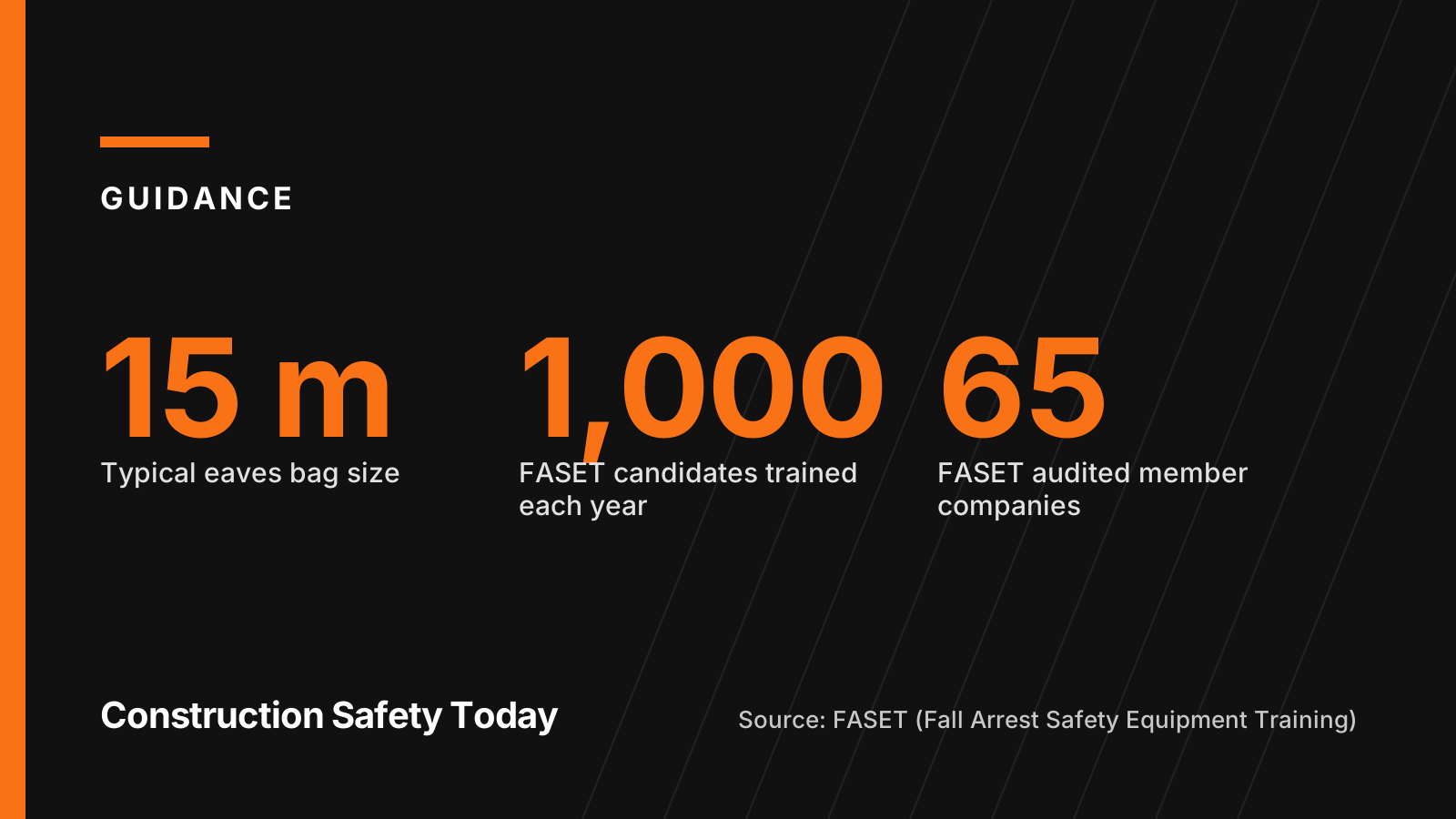
- Normal practice is to form the bag from about 15 meshes, although this may vary with site conditions and the span of the bag.
- There is no limit on the length of an eaves bag.
- The border rope along the length of the bag must be straight and the tear drop ends suitably closed up.
The web page links to a downloadable version of the bulletin. FASET encourages users to view its bulletins on the website rather than rely on downloaded copies, so that they always read the current version.
The wider gap rules
The eaves bags bulletin sits alongside FASET's separate guidance on maximum permissible gaps. That document allows a gap of up to 225mm only in exceptional cases, such as around large service pipes or heating ducts, and says efforts must still be made to reduce the gap as much as possible.
Where a gap over 225mm cannot be reduced, FASET said those working above the net must put additional safety measures in place in that area.
Other bulletins in the series cover joining nets, loading, inspections and rescue.
The regulator's position
The Health and Safety Executive (HSE) describes nets as a complex energy-absorbing system that must only be rigged, maintained, modified and de-rigged by trained and competent people.
HSE says nets should be positioned as close as possible to the working level to minimise the height of a fall. A competent person must inspect a net system after installation and prepare a handover certificate, and the system must then be inspected weekly to confirm it is still fixed correctly and will arrest a fall.
Under HSE's work at height hierarchy, collective protection should be used before personal protection. The regulator lists safety nets and soft landing systems, installed close to the level of the work, among measures to minimise the consequences of a fall.
About FASET
FASET describes itself as the trade association and training body for the safety net and temporary safety systems industry and has operated since 2003. It says it trains more than 1,000 candidates a year and has more than 65 audited member companies.
The legal entity behind the body is registered at Companies House as Fall Arrest Safety Equipment Training, company number 04638898, a private company limited by guarantee without share capital, incorporated on 16 January 2003.
Sources
- FASET (opens in a new tab) (accessed 2026-10-07)
- FASET (opens in a new tab) (accessed 2026-10-07)
- FASET (opens in a new tab) (accessed 2026-10-07)
- FASET (opens in a new tab) (accessed 2026-10-07)
- FASET (opens in a new tab) (accessed 2026-10-07)
- Companies House (opens in a new tab) (accessed 2026-10-07)
- Health and Safety Executive (opens in a new tab) (accessed 2026-10-07)
- Health and Safety Executive (opens in a new tab) (accessed 2026-10-07)
This story was researched from the primary sources above and checked against them before publication. Spotted an error? Tell us and we will correct it promptly.