wellbeing
HSE calls on employers to review stress risk assessments ahead of Stress Awareness Week
The regulator is using its Working Minds campaign to push employers towards treating work-related stress as a health and safety risk, as its own figures show stress accounts for more than half of work-related ill health.
The Health and Safety Executive (HSE) has urged employers and managers to assess and manage work-related stress in the same way as any other workplace risk, ahead of Stress Awareness Week on 2-6 November 2026.
In a release issued on 31 October, the regulator said work-related stress remained one of the leading causes of work-related ill health in Great Britain, and that many employers still did not realise they had to assess and manage its risks alongside other health and safety risks.
HSE said employers have a legal duty to assess and manage risks to workers' health, including risks to mental health.
Kayleigh Roberts, HSE's Work-Related Stress Policy Lead, said: "Work-related stress is a health and safety issue. Employers should assess the risks of stress, and its impact on mental and physical ill-health, in the same way they assess other work-related health and safety risks."
The 5Rs and the Management Standards
Through its Working Minds campaign, HSE is promoting a five-step approach it calls the 5Rs: Reach Out, Recognise, Respond, Reflect and Make it Routine. The campaign page defines Reach Out as starting conversations with your team, and Make it Routine as regularly checking in on how people are coping.
The regulator is also highlighting its Management Standards, which cover six areas of work: demands, control, support, relationships, role and change. According to HSE, these areas are associated with poor health, lower productivity and increased accident and sickness absence rates when they are not properly managed.
HSE defines the Demands standard as covering workload, work patterns and the work environment, and the Change standard as how organisational change, large or small, is managed and communicated. The regulator said that following the Management Standards approach correctly is considered a suitable and sufficient approach to stress risk assessment.
What HSE wants employers to do
During the week, HSE said employers should review their stress risk assessment where necessary to make sure it reflects current workplace risks, use its Talking Toolkit to hold structured conversations with workers, discuss the six Management Standards areas with their teams, and encourage managers to access Working Minds training.
The Working Minds resources, which HSE said are free, include the Talking Toolkit, a Stress Indicator Tool, online learning modules and downloadable guidance.
Roberts said: "Stress Awareness Week is a valuable opportunity for employers and managers to review what they are doing, start conversations with workers and take practical steps to prevent work-related stress."
The figures behind the campaign
The release itself carries no statistics, but HSE's annual workplace health and safety figures, published in November 2025, put the scale of the problem in context. HSE estimated that 1.9 million workers suffered from work-related ill health in 2024/25, of whom 964,000 reported stress, depression or anxiety caused or made worse by work.
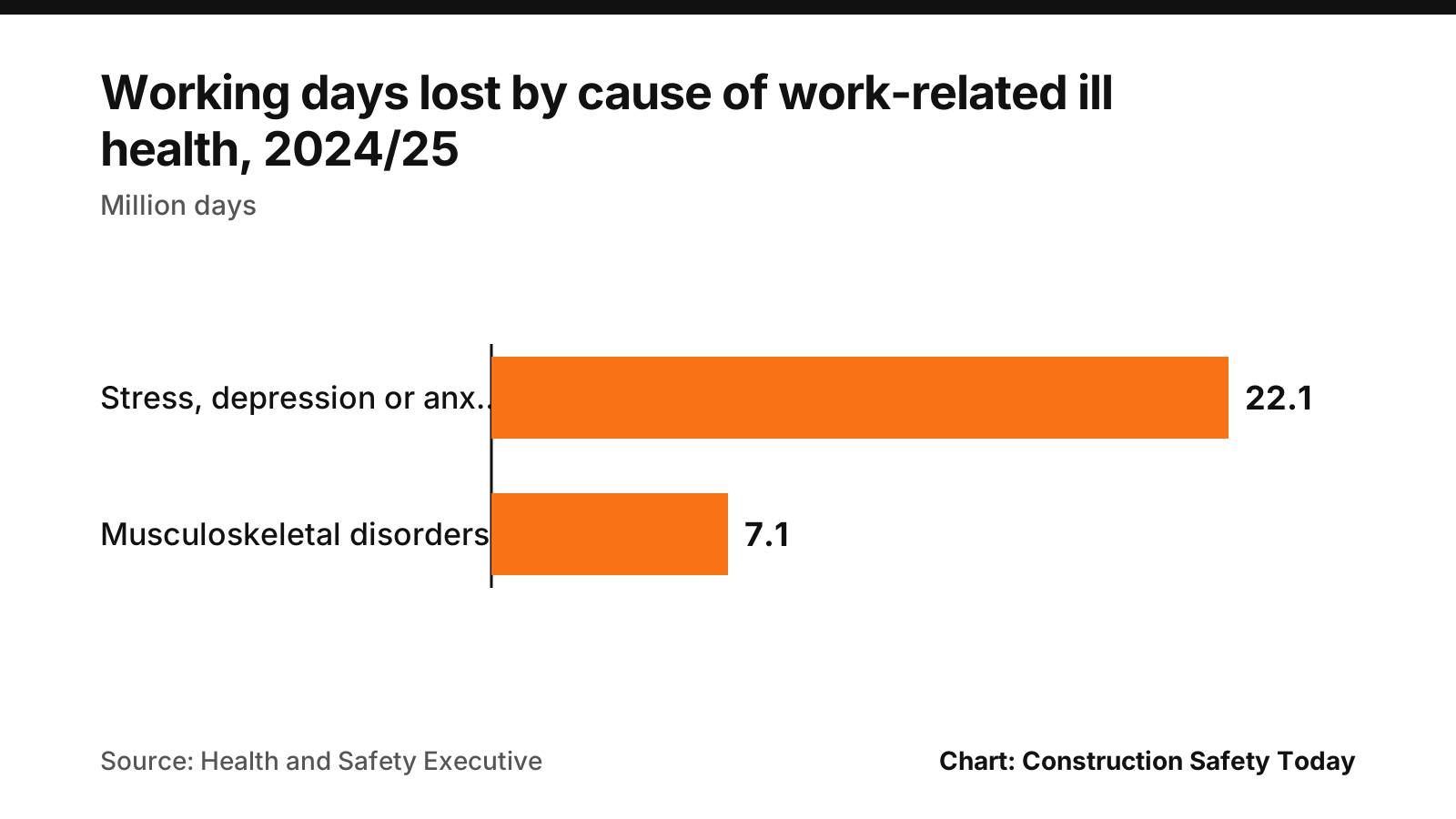
In a release on World Mental Health Day, 10 October 2026, HSE said stress, depression or anxiety accounted for 52% of all work-related ill health and resulted in 22.1 million working days lost. The Working Minds campaign page puts it more simply: stress, depression and anxiety cause more than half of work-related ill health.
HSE's working days lost statistics for 2024/25 show how stress compares with the other main cause of ill-health absence.
| Cause of ill health, 2024/25 | Working days lost |
|---|---|
| Stress, depression or anxiety | 22.1 million |
| Musculoskeletal disorders | 7.1 million |
Each person suffering stress, depression or anxiety took an average of 22.9 days off work, according to HSE, against around 16.4 days on average across all work-related ill health and injury. Across the whole economy, HSE estimated 40.1 million working days were lost to work-related ill health and injury in 2024/25.
Construction's position
HSE's industry statistics give construction a self-reported work-related ill health rate of 3,790 per 100,000 workers, with a confidence interval of 3,115 to 4,466. The same figures list construction among the sectors whose self-reported non-fatal injury rate is statistically significantly higher than the average across all industries.
HSE's ill-health statistics are based on the Labour Force Survey and cover workers suffering new or long-standing work-related ill health in 2024/25.
The 31 October release is HSE's second Working Minds push in three weeks. The World Mental Health Day release on 10 October was also fronted by Roberts, who used it to make a similar call to employers.
HSE said that while Stress Awareness Week provides a focus, preventing and managing work-related stress should remain a priority throughout the year. Stress Awareness Week runs from 2 to 6 November 2026.
Sources
- Health and Safety Executive (opens in a new tab) (accessed 2026-10-31)
- Health and Safety Executive (Work Right campaign site, GOV.UK) (opens in a new tab) (accessed 2026-10-31)
- Health and Safety Executive (opens in a new tab) (accessed 2026-10-31)
- Health and Safety Executive (opens in a new tab) (accessed 2026-10-31)
- Health and Safety Executive (opens in a new tab) (accessed 2026-10-31)
- Health and Safety Executive (opens in a new tab) (accessed 2026-10-31)
- Health and Safety Executive (opens in a new tab) (accessed 2026-10-31)
- Health and Safety Executive (opens in a new tab) (accessed 2026-10-31)
This story was researched from the primary sources above and checked against them before publication. Spotted an error? Tell us and we will correct it promptly.