guidance
Cladding remediation Bill reaches second reading with £500,000 penalties proposed
MPs are to discuss the Building Safety (Remediation of Unsafe Cladding etc) Bill at its second reading on 27 October, CHSG said, with MHCLG proposing tribunal penalties, a medium-rise register and PAS 9980 appraisals.
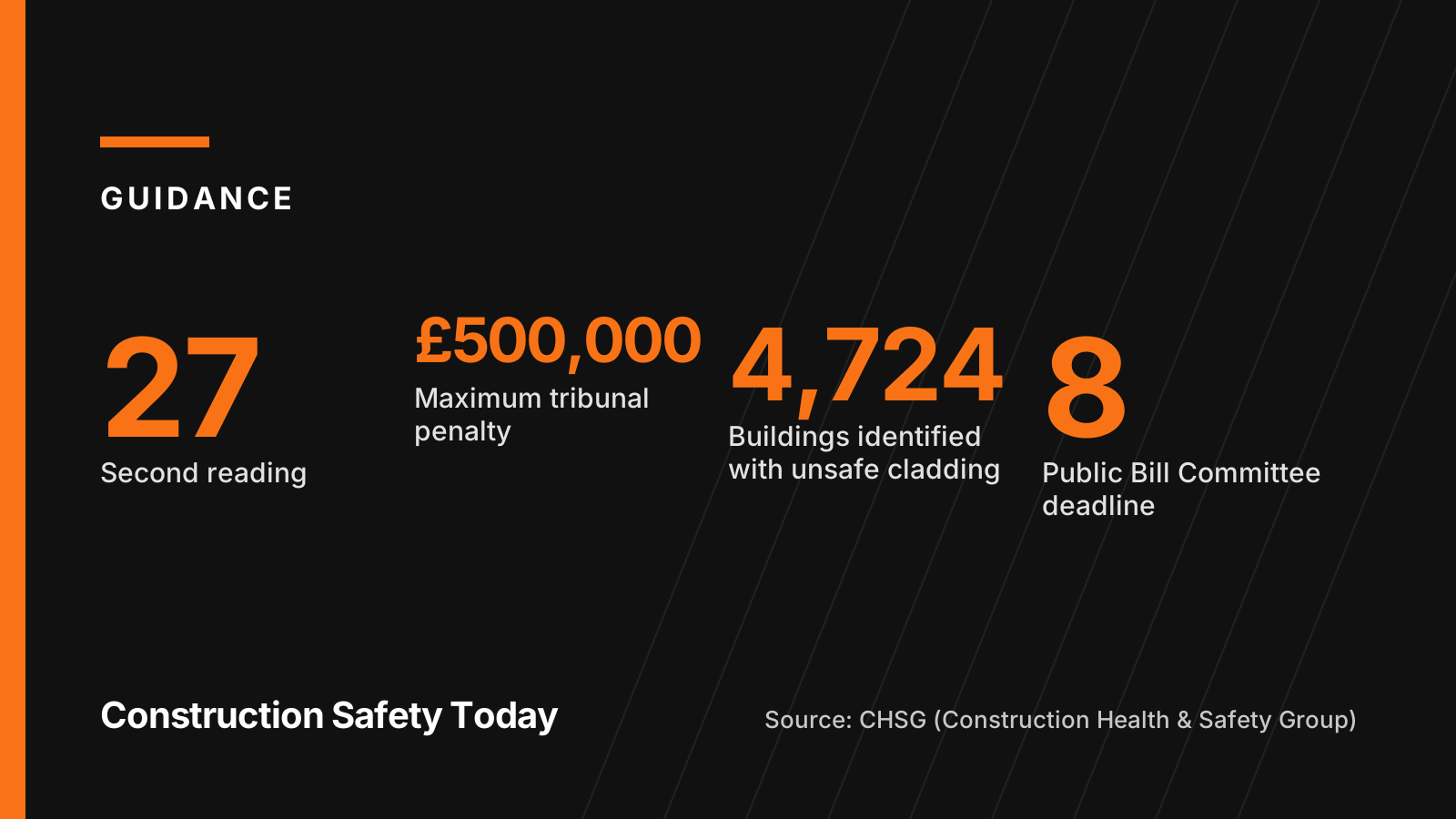
The Building Safety (Remediation of Unsafe Cladding etc) Bill has reached its second reading in the House of Commons, the Construction Health & Safety Group (CHSG) said on 27 October, bringing proposed penalties of up to £500,000 for those who fail to remediate closer to the statute book.
CHSG, a training charity founded in 1952, said the Bill, proposed by the Ministry of Housing, Communities and Local Government (MHCLG), sets out measures to speed up remediation of unsafe cladding on residential buildings in England. It was first read in Parliament on 14 October, MPs will discuss the finer points of the Bill at second reading on 27 October, and the Public Bill Committee has until 8 December to finish its considerations, subject to proceedings, CHSG said.
MHCLG said when it introduced the Bill on 14 October 2026 that it expects the legislation to accelerate remediation for around 12,000 residents.
Baroness Blake, Building Safety Minister, said it was "unacceptable that so many people have been left living in homes with dangerous cladding".
Who the duties would apply to
According to MHCLG's guide to the Bill, the legal duty to remediate would apply to multi-occupied residential buildings in England over 11 metres or with at least five storeys, completed before 28 June 2022.
The duties to assess, mitigate and remediate would come into force two months after Royal Assent, the guide said. Those responsible for in-scope buildings would then have to assess them for fire-safety risks within twelve months of the legislation coming into force.
The Bill would require fire risk appraisals of external walls (FRAEWs) to follow the PAS 9980 methodology, to be set out in regulations, and Homes England would audit FRAEWs across England, including in London, MHCLG said.
Where an FRAEW recommends remedial work, responsible entities would have to produce a Remediation Compliance Plan, due 15 months from Royal Assent, and share a plan with residents, according to MHCLG.
Penalties and enforcement
MHCLG said the Bill would let the First-tier Tribunal impose financial penalties of up to £500,000 on responsible entities that fail to comply with a Remediation Order. An individual found obstructing assessment or remediation would be liable for a fine of up to £40,000, the guide said.
The Bill would also introduce a register of all residential buildings 11 to 18 metres high in England. Failure to register could bring civil penalties of up to £7,000, rising to £40,000, MHCLG said.
Where those responsible continuously fail to act, third parties such as Homes England or local authorities would be able to step in and carry out remediation, which the guide describes as a last-resort backstop mechanism.
Developers, contractors and others who have paid to make buildings safe would get a simpler route to pursue cladding manufacturers for costs, according to MHCLG. CHSG said this would make it easier to recover remediation costs from manufacturers of unsafe cladding products.
Charlie Pugsley, Acting CEO for Building Safety Regulator, said: "BSR is fully engaged with stakeholders to support building owners in fixing known buildings faster."
The remediation backlog
MHCLG's monthly data release shows the scale of work the Bill targets. As at the end of August 2026, 4,724 residential buildings 11 metres and over had been identified with unsafe cladding. Of those, 1,849 (39% of monitored buildings) had completed remediation works.
MHCLG said over 470 more buildings have reportedly completed cladding remediation since the Remediation Acceleration Plan was published, helping around 35,000 more residents, and that the government has committed over £5bn to remediation.
The department's July 2025 update to the plan said remediation had started or been completed on 2,490 of the identified 11m+ buildings as at the end of June 2025, and estimated that between 500 and 3,400 buildings with unsafe cladding were still to be brought into a remediation programme.
The targets
CHSG and MHCLG both linked the Bill to the government target that, by the end of 2029, every building over 11 metres with unsafe cladding should have been remediated or have a clear completion date.
In July 2025, MHCLG said every 18m+ residential building in a government funded scheme would be remediated by the end of 2029, that the planned Bill would require landlords of 11 to 18 metre buildings to complete remediation by the end of 2031, and that 2031 would mark the natural end date for works on those buildings. The October 2026 guide to the Bill sets its assessment and compliance plan duties relative to Royal Assent.
Subject to proceedings, the Public Bill Committee's deadline to finish its considerations is 8 December, CHSG said.
On the record: Ministry of Housing, Communities and Local Government, Homes England
Sources
- CHSG (opens in a new tab) (accessed 2026-10-27)
- CHSG (opens in a new tab) (accessed 2026-10-27)
- Ministry of Housing, Communities and Local Government (opens in a new tab) (accessed 2026-10-27)
- Ministry of Housing, Communities and Local Government (opens in a new tab) (accessed 2026-10-27)
- Ministry of Housing, Communities and Local Government (opens in a new tab) (accessed 2026-10-27)
- Ministry of Housing, Communities and Local Government (opens in a new tab) (accessed 2026-10-27)
- Ministry of Housing, Communities and Local Government (opens in a new tab) (accessed 2026-10-27)
This story was researched from the primary sources above and checked against them before publication. Spotted an error? Tell us and we will correct it promptly.