guidance
Homes England will not fund cladding works on blocks set for demolition unless it agrees an exception
Updated Cladding Safety Scheme guidance says the fund will not pay for works on buildings with a limited remaining life where demolition is planned, unless Homes England agrees an exception.
Homes England has amended its Cladding Safety Scheme guidance to say the fund will not pay for works on buildings with a limited remaining life where demolition is planned, unless the agency agrees an exception.
The change, dated 21 October 2026, appears in the scheme's overview document on GOV.UK. Homes England said it had "made it clear that the scheme will not fund the cost of work on buildings with a limited remaining life where demolition is planned, unless we agree an exception".
The Cladding Safety Scheme (CSS) is a government fund, delivered by Homes England on behalf of the Ministry of Housing, Communities and Local Government (MHCLG), that meets the cost of addressing life safety fire risks associated with cladding on residential buildings in England. It was formally launched in July 2023, and Homes England uses Davies Group to help administer it.
The exclusion
Homes England has kept a route for exceptions. The overview says there can be complex circumstances and structures that the policy cannot consider at a broad level, and it invites applicants in that position to contact the CSS team, which it said has experience of dealing with a variety of policy exceptions.
The demolition change is the latest in a series of amendments to the guidance this year. On 10 July 2026, Homes England removed a reference to local authority support from the section on decanting residents in its separate 'Applying for funding' document. On 9 July 2026 it amended both documents to reflect that the scheme applies to cladding fire safety risks on residential buildings in England, and added a link to new funding for buildings under 11 metres.
Who is applying
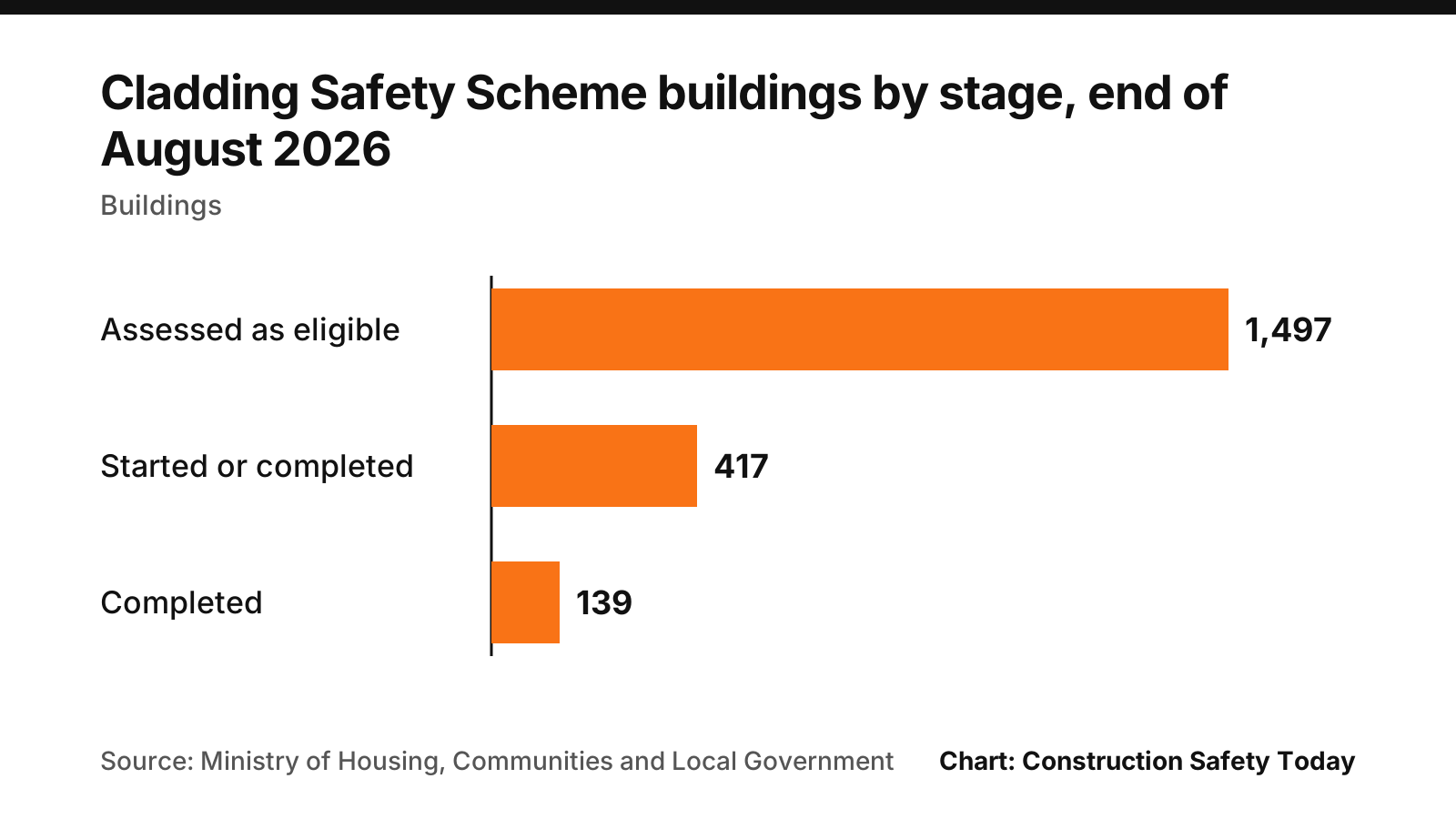
MHCLG's monthly building safety remediation data gives a picture of the pipeline the new rule applies to. As at 31 August 2026, 1,497 buildings 11 metres and over had been assessed as eligible for the CSS, of which 280 had transferred from the Building Safety Fund.
| CSS stage, end of August 2026 | Buildings |
|---|---|
| Assessed as eligible | 1,497 |
| Started or completed works on site | 417 |
| Completed works on site | 139 |
Of the eligible buildings, 417 (28%) had started or completed remediation works on site, and 139 (9%) had completed works, according to MHCLG. A further 1,846 buildings had a live application progressing through the eligibility stages.
Since July 2025 the guidance has reflected government policy giving social landlords the same access to remediation funding as private building owners. For social sector buildings there is no lease requirement, but at least one unit must be owned by a provider registered with the Regulator of Social Housing. From 1 September 2025, all new applications to address life safety fire risks on residential buildings over 11 metres in England have had to be made through the CSS.
Wider programme
Across all remediation programmes, MHCLG said 4,724 residential buildings 11 metres and over had been identified with unsafe cladding at the end of August 2026, with 2,571 (54%) started or completed and 1,849 (39%) completed. The department's best estimate, as of March 2026, is that between 5,900 and 7,400 residential buildings 11 metres and over in England have or had unsafe cladding requiring work.
The guidance change comes a week after the government introduced the Remediation of Unsafe Cladding Bill to Parliament on 14 October 2026. MHCLG said the Bill would enable the First-tier Tribunal to impose financial penalties of up to £500,000, and that more than 470 further buildings had completed cladding remediation since the Remediation Acceleration Plan was published.
Baroness Blake, Building Safety Minister, said: "This Bill is a milestone in our mission to right these wrongs."
Homes England said in the same announcement that it would continue working with government, regulators and industry partners to help ensure no building falls through the cracks.
The Remediation Acceleration Plan set a target that by the end of 2029 all 18-metre-plus buildings with unsafe cladding in a government-funded scheme will have been remediated. The plan also said every 11-metre-plus building with unsafe cladding would by then have been remediated or have a completion date, or its landlords would face what the plan described as severe penalties.
Homes England also administers a separate fund for buildings under 11 metres through the CSS. The application window for that fund closed on 9 October 2026, and applicants for buildings over 11 metres are told to continue following the Cladding Safety Scheme guidance.
On the record: Homes England, Ministry of Housing, Communities and Local Government, Davies Group
Sources
- Homes England (GOV.UK) (opens in a new tab) (accessed 2026-10-21)
- Homes England (GOV.UK) (opens in a new tab) (accessed 2026-10-21)
- Ministry of Housing, Communities and Local Government (GOV.UK) (opens in a new tab) (accessed 2026-10-21)
- Ministry of Housing, Communities and Local Government (GOV.UK) (opens in a new tab) (accessed 2026-10-21)
- Ministry of Housing, Communities and Local Government (GOV.UK) (opens in a new tab) (accessed 2026-10-21)
- Ministry of Housing, Communities and Local Government and Homes England (GOV.UK) (opens in a new tab) (accessed 2026-10-21)
This story was researched from the primary sources above and checked against them before publication. Spotted an error? Tell us and we will correct it promptly.