wellbeing
HSE publishes OSCAR research on managing work-related stress
The regulator says findings from its Occupational Stress Consultation and Research programme will help it develop its guidance for duty holders after finding employer responses to stress are often reactive rather than preventative.

The Health and Safety Executive (HSE) published findings on 23 November from its Occupational Stress Consultation and Research programme (OSCAR), which it said would help employers identify and manage the psychosocial hazards behind work-related stress.
The regulator listed those hazards as excessive demands, low control, poor support, workplace conflict, role uncertainty and organisational change. It said the research provides evidence to support its work on preventing and managing work-related stress.
Sandra Gadd, Deputy Director in HSE's Science, Engineering and Analysis Division, said the work had filled gaps in the evidence base needed to inform the regulator's future approach.
"This research will help us further develop our guidance for duty holders to provide greater clarity and to help duty holders more effectively identify relevant risks and implement appropriate controls," she said.
The research
The findings are published as HSE research report RR1232, Occupational Stress Consultation and Research - Project OSCAR. According to HSE, the work was carried out by Affinity Health at Work with partners the Institute of Employment Studies and the Institute of Occupational Medicine, using evidence reviews, interviews and stakeholder engagement.
Its purpose, HSE said, was to build the evidence base on how work-related stress is understood, identified and managed in practice across workplaces.
The findings appear in an overarching summary report and three thematic reports. The first looks at how work-related stress is defined and labelled by organisations and medical professionals, the second at which interventions are effective for preventing and managing it, and the third at the enablers and barriers to organisations reducing the risks.
HSE said the research found no shared understanding of how work-related stress is defined and labelled, and that organisational responses are often reactive rather than preventative. It also found that stronger evaluation and sharing of learning would improve understanding of what works, and that the key challenge is turning existing knowledge into coordinated prevention activity.
Mike Calcutt, Deputy Director in HSE's Engagement and Policy Division, said: "A key challenge is how to shift organisational approaches to preventative measures based on an improved understanding of what works in practice, rather than all too often reactive responses to work-related stress."
He said employers are required by law to protect their employees from harm, and that this includes harm arising from psychosocial hazards. The OSCAR reports, he said, confirmed the need to focus more on preventing and managing psychosocial risks and involving workers in developing solutions.
The figures
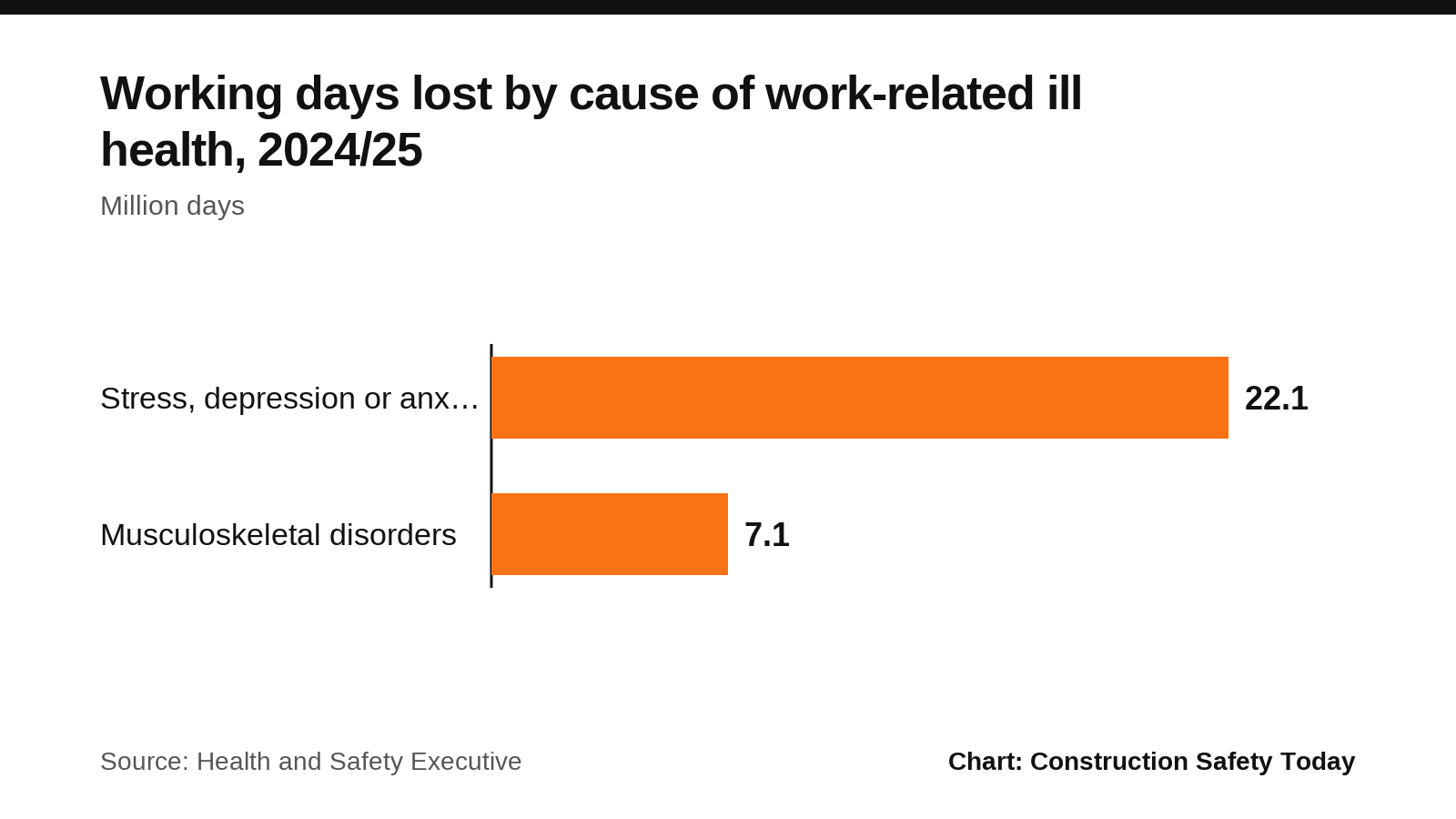
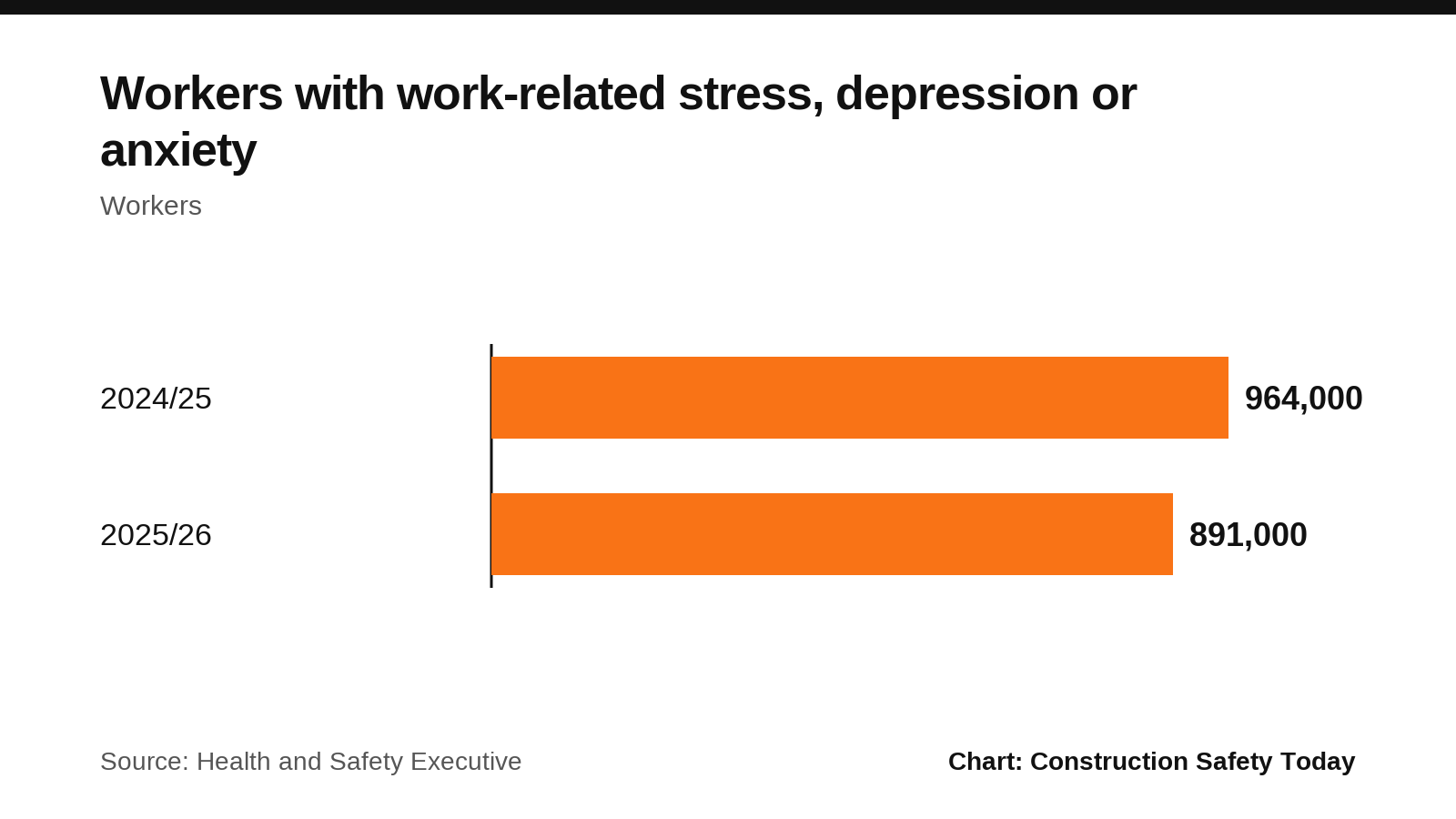
The research follows HSE's annual workplace health and safety statistics for 2025/26, published last week. These estimated that 891,000 workers suffered work-related stress, depression or anxiety in 2025/26, down from 964,000 in 2024/25, and that 18.2 million working days were lost to the condition, down from 22.1 million.
| Measure | 2024/25 | 2025/26 |
|---|---|---|
| Workers with work-related stress, depression or anxiety | 964,000 | 891,000 |
| Working days lost to stress, depression or anxiety (million) | 22.1 | 18.2 |
| Share of all work-related ill health | 52% | 49% |
Stress, depression or anxiety made up 49% of all work-related ill health in 2025/26, compared with 52% a year earlier, HSE said. Overall, an estimated 1.8 million workers suffered work-related ill health in the year, against 1.9 million in 2024/25, accounting for 35.0 million working days lost.
Sarah Albon, HSE Chief Executive, said at the time that stress continuing to account for half of all work-related illness should send a strong signal to businesses. HSE puts the estimated cost of injuries and ill health from current working conditions at £24.6bn for 2024/25.
The legal footing
HSE says the Management of Health and Safety at Work Regulations 1999 require employers to assess risks to employees' health and safety from their work activities, and that employers have a legal duty to protect workers from stress by doing a risk assessment and acting on it.
Its Management Standards cover six areas of work design: demands, control, support, relationships, role and change. Demands covers workload, work patterns and the work environment; control is how much say a person has in the way they do their work; and change is how organisational change, large or small, is managed and communicated. HSE says the standards simplify stress risk assessment by identifying the main risk factors, and its Working Minds campaign is built around them.
HSE said the reports will be of interest to employers, practitioners, policymakers, academics and researchers working on psychosocial risk. The full report and related documents are on the HSE website.
Sources
- Health and Safety Executive (opens in a new tab) (accessed 2026-11-23)
- Health and Safety Executive (opens in a new tab) (accessed 2026-11-23)
- Health and Safety Executive (opens in a new tab) (accessed 2026-11-23)
- Health and Safety Executive (opens in a new tab) (accessed 2026-11-23)
- Health and Safety Executive (opens in a new tab) (accessed 2026-11-23)
- Health and Safety Executive (opens in a new tab) (accessed 2026-11-23)
- Health and Safety Executive (opens in a new tab) (accessed 2026-11-23)
This story was researched from the primary sources above and checked against them before publication. Spotted an error? Tell us and we will correct it promptly.