guidance
RAIB opens investigation into freight train derailment at Barking
The Rail Accident Investigation Branch is examining the derailment of a wagon on a GB Railfreight intermodal train near Barking station on 23 October, in which no injuries were reported.
The Rail Accident Investigation Branch (RAIB) has opened an investigation into the derailment of a GB Railfreight intermodal train near Barking station in Greater London on 23 October 2026, it announced on 12 November.
RAIB said one wagon of the train derailed at about 13:04 on the Up Tilbury Line, about 700 metres south-east of the station. There were no reported injuries, but the branch said the wagon, the track, signalling equipment and adjacent infrastructure suffered significant damage.
The train was made up of two Class 99 bi-mode locomotives, one of which was being dead hauled, and 39 intermodal container wagons. According to RAIB, it was running between the rail freight terminals at London Gateway and Hams Hall.
RAIB is not a prosecuting body and does not apportion blame or liability. It said its investigation will examine the cause and sequence of events leading up to the derailment.
What the data recorder showed
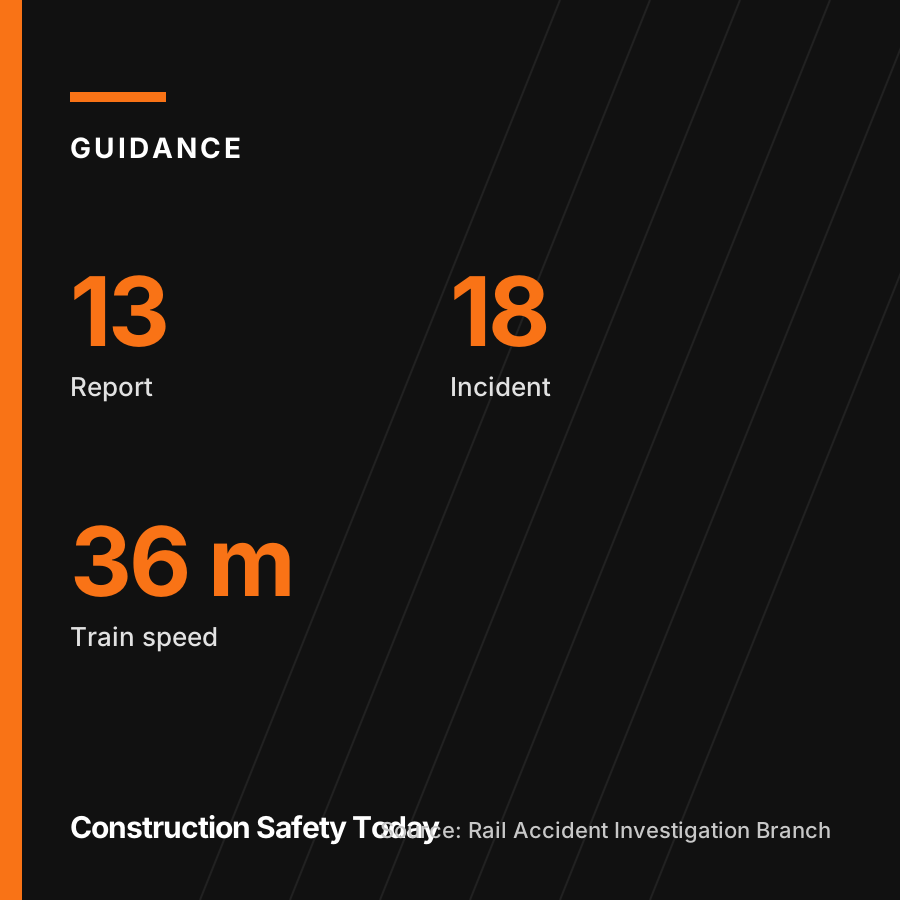
Preliminary analysis of the leading locomotive's on-train data recorder, RAIB said, showed the train was travelling at about 8 mph (13 km/h) when its brakes applied and brought it to a stand. After about two minutes it began moving again.
The 20th wagon from the front derailed during these movements. RAIB said the train was then driven for about 0.7 miles (1.1 km) with the derailed wagon's wheels running on the sleepers and ballast, passing through platform 8 at Barking station.
The train stopped north of the station after the signaller, who had noticed a loss of detection on multiple sets of points, contacted the driver.
Scope of the investigation
Alongside the cause and sequence of events, RAIB said its investigation will consider the actions of those involved and the factors that may have influenced them, the mechanism by which the wagon derailed, the loading and preparation of the train, the design and dynamic characteristics of the vehicles, the status of the infrastructure at the location and any underlying management factors.
RAIB said its investigation is independent of any inquiry by the railway industry or by the Office of Rail and Road, the industry's regulator.
It will publish its findings, including any recommendations to improve safety, when the investigation concludes.
The Class 99 fleet
GB Railfreight said it announced in early 2022 the procurement of 30 bi-mode Class 99s in partnership with Beacon Leasing and Stadler. The company describes the Class 99 as a Co-Co locomotive combining 25 kV AC electric and diesel operating modes, which it said will cut emissions by about 50% per journey and replace its Class 66 locomotives.
On 17 June 2026 a Class 99 hauled a live intermodal trial service between London Gateway and Hams Hall, which GB Railfreight described as one of the final milestones before full commercial service.
The first commercial Class 99 service ran on 28 July 2026, GB Railfreight said, departing DP World London Gateway for Maritime Transport and bound for Maritime's Hams Hall Rail Freight Terminal in the West Midlands.
RAIB's published learning on freight derailments
RAIB has previously published a summary of learning from freight train derailments. These are the branch's general observations from earlier investigations and are not findings about Barking, where the investigation has only just begun.
In the summary, RAIB said it is important that vehicles are designed to maximise their resistance to derailment. It said the standard of maintenance of freight wagons had been a matter of concern in several of its investigations, and that other factors, including rail wear and railhead condition, can also be among the causes of accidents.
The same summary said wheel flats caused by unreleased handbrakes can result in track damage or derailment when the affected wheels reach pointwork.
The Barking report, with any safety recommendations, will be published on the RAIB website once the investigation is complete.
On the record: Office of Rail and Road
Sources
- Rail Accident Investigation Branch (GOV.UK) (opens in a new tab) (accessed 2026-11-12)
- Rail Accident Investigation Branch (GOV.UK) (opens in a new tab) (accessed 2026-11-12)
- Rail Accident Investigation Branch (GOV.UK) (opens in a new tab) (accessed 2026-11-12)
- GB Railfreight (opens in a new tab) (accessed 2026-11-12)
- GB Railfreight (opens in a new tab) (accessed 2026-11-12)
- GB Railfreight (opens in a new tab) (accessed 2026-11-12)
This story was researched from the primary sources above and checked against them before publication. Spotted an error? Tell us and we will correct it promptly.